减重代谢术后营养管理是手术疗效与安全保障的关键,维生素B1缺乏虽不算高发,却存在致命的神经系统并发症风险。本文结合国内外权威指南,梳理术后维生素B1缺乏风险及补充建议。
Original Passage
Thiamine (vitamin B1) supplementation above the recommended dietary allowance (RDA) is suggested to prevent thiamine deficiency (Grade D). Routine thiamine screening may be considered following bariatric procedures (Grade C; BEL 3). Aggressive case finding for thiamine deficiency and/or empiric thiamine supplementation is indicated for high-risk postprocedure patients, such as those with established preprocedure risk factors for thiamine deficiency, females, African Americans, patients not attending a nutritional clinic, patients with GI symptoms, and patients with heart failure, protracted vomiting, PN, excessive alcohol use, neuropathy or encephalopathy (Grade C; BEL 3), or small intestinal bacterial overgrowth (SIBO) (Grade C; BEL 3). All post-WLS patients should take at least 12 mg thiamine daily (Grade C; BEL 3). A 50-100 mg daily dose of thiamine from a B-complex supplement or high-potency multivitamin may be needed to maintain sufficient blood levels of thiamine and prevent thiamine deficiency in some patients (Grade D). Patients with severe thiamine deficiency (suspected or established) should be treated with IV (or intramuscular if IV access is not available) thiamine, 500 mg/d for 3 to 5 days, followed by 250 mg/d for 3 to 5 days or until resolution of symptoms, with consideration of treatment with 100 mg/d orally usually indefinitely or until risk factors have resolved (Grade C; BEL 3). Mild deficiency can be treated with intravenous thiamine, 100 mg/d for 7 to 14 days (Grade C; BEL 3). In patients with recalcitrant or recurrent thiamine deficiency with 1 of the aforementioned risks, the addition of antibiotics for SIBO should be considered (Grade C; BEL 3).
——cosponsored by AACE/TOS/ASMBS/OMA/ASA(2020)
Table 9 Minimum recommended micronutrient intake for metabolic bariatric surgery procedures
| Nutrient | Recommended supplementation SG or RYGB | Recommended supplementation BPD-DS or SADI-S |
| Vitamin B1 (thiamin) | At least 12 mg oral daily | At least 12 mg oral daily |
Table 10 American Society of Bariatric and Metabolic Surgery recommendations for micronutrient repletion
| Vitamin/ Mineral | Repletion Therapy Options |
| Thiamin | Oral therapy: 100 mg 2-3x/d IV therapy: 200 mg 3x/d or 500 mg 1-2x/d for 3-5 d; then 250 mg/d for 3-5 d IM therapy: 250 mg 1x/d for 3-5 d or 100-250 mg monthly |
——CPS by OMA (2024)
中文译文
建议高于推荐膳食供给量(RDA)补充硫胺素(维生素B1),以预防硫胺素缺乏症(推荐等级D)。减重代谢手术后可考虑进行常规硫胺素筛查(推荐等级C;证据等级3)。对于术后高风险患者,如存在明确的术前硫胺素缺乏症危险因素者、女性、非裔美国人、未前往营养门诊就诊的患者、伴有胃肠道症状的患者、心力衰竭、持续性呕吐、肠外营养(PN)、过量饮酒、神经病变或脑病(推荐等级C;证据等级3)或小肠细菌过度生长(SIBO)(推荐等级C;证据等级3)的患者,应开展积极的硫胺素缺乏病例筛查和/或进行经验性硫胺素补充治疗。所有减重术后的患者应每日至少补充12 mg硫胺素(推荐等级C;证据等级3)。部分患者需要通过B族复合维生素或高效复合维生素片,每日补充50‑100 mg硫胺素,以维持充足血清硫胺素水平并预防硫胺素缺乏症(推荐等级D)。存在严重硫胺素缺乏症(疑似或确诊)的患者,应采用静脉注射(若无法建立静脉通路则采用肌肉注射)硫胺素治疗,剂量为500 mg/天,持续3至5天;随后调整为250 mg/天,持续3至5天或直至症状缓解;也可考虑采用口服100 mg/天的治疗方案,通常需长期服用或直至危险因素消除(推荐等级C;证据等级3)。轻度缺乏症可采用静脉注射硫胺素治疗,剂量为100 mg/天,持续7至14天(推荐等级C;证据等级3)。对于存在上述任一风险因素且患有顽固性或复发性硫胺素缺乏症的患者,应考虑加用抗生素治疗SIBO(推荐等级C;证据等级3)。
表9 代谢减重手术后微量营养素的最低推荐摄入量
| 营养素 | SG/RYGB术后推荐补充量 | BPD-DS/SADI-S术后推荐补充量 |
| 维生素B1 (硫胺素) | 每日至少口服12毫克 | 每日至少口服12毫克 |
表10 美国减重和代谢外科学会微量营养素补充推荐方案
| 维生素/ 矿物质 | 营养素补充治疗方案 |
| 硫胺素 | 口服治疗:100毫克,每日2-3次 静脉注射治疗:200 mg,每日3次;或500 mg,每日1-2次,持续3-5天;随后改为250 mg/日,持续3-5天 肌肉注射治疗:250 mg,每日一次,持续3-5天;或100-250 mg,每月一次 |
——美国肥胖医学协会(OMA)临床实践声明(2024)
国内指南
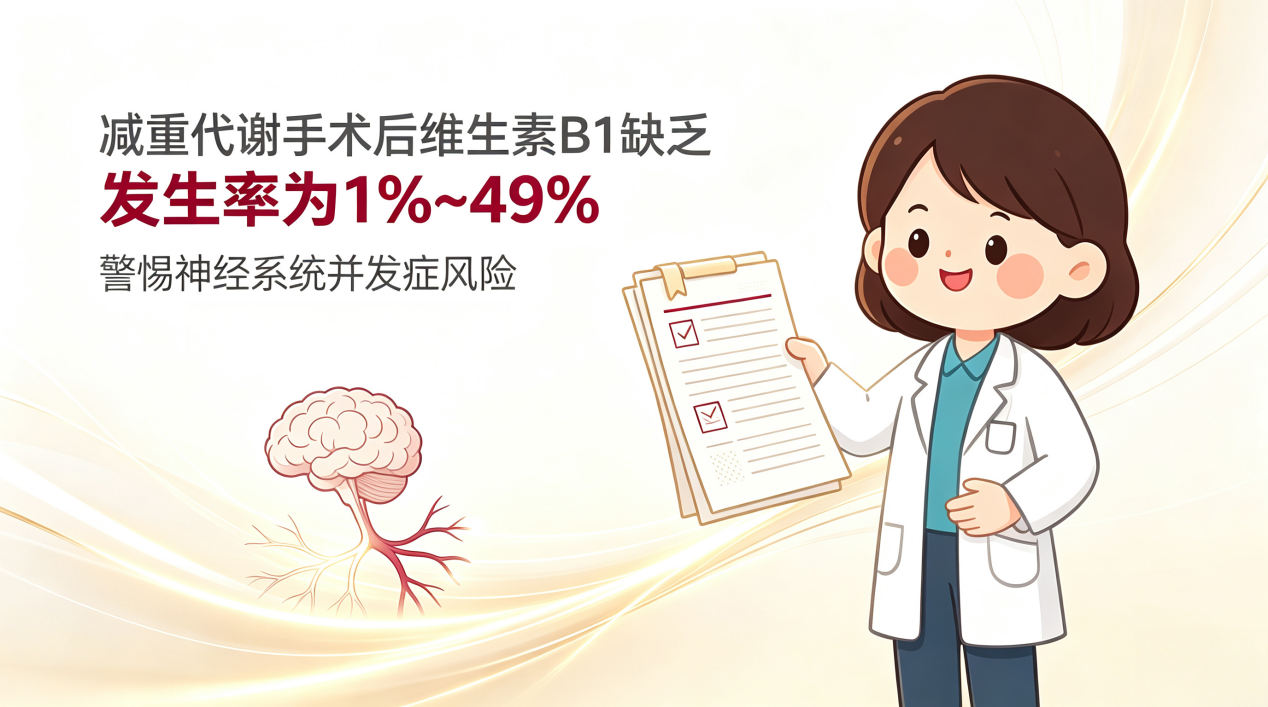
减重代谢手术后维生素B1缺乏发生率为1%~49%,建议补充≥12 mg/d。
——中国肥胖及代谢疾病外科治疗指南(2024版)
补充足量的多种维生素与微量元素,术后常规服用复合维生素和微量元素制剂,并补充关键元素包括维生素B1(50-100mg/日)。
——肥胖症诊疗指南(2024年版)
小贴士
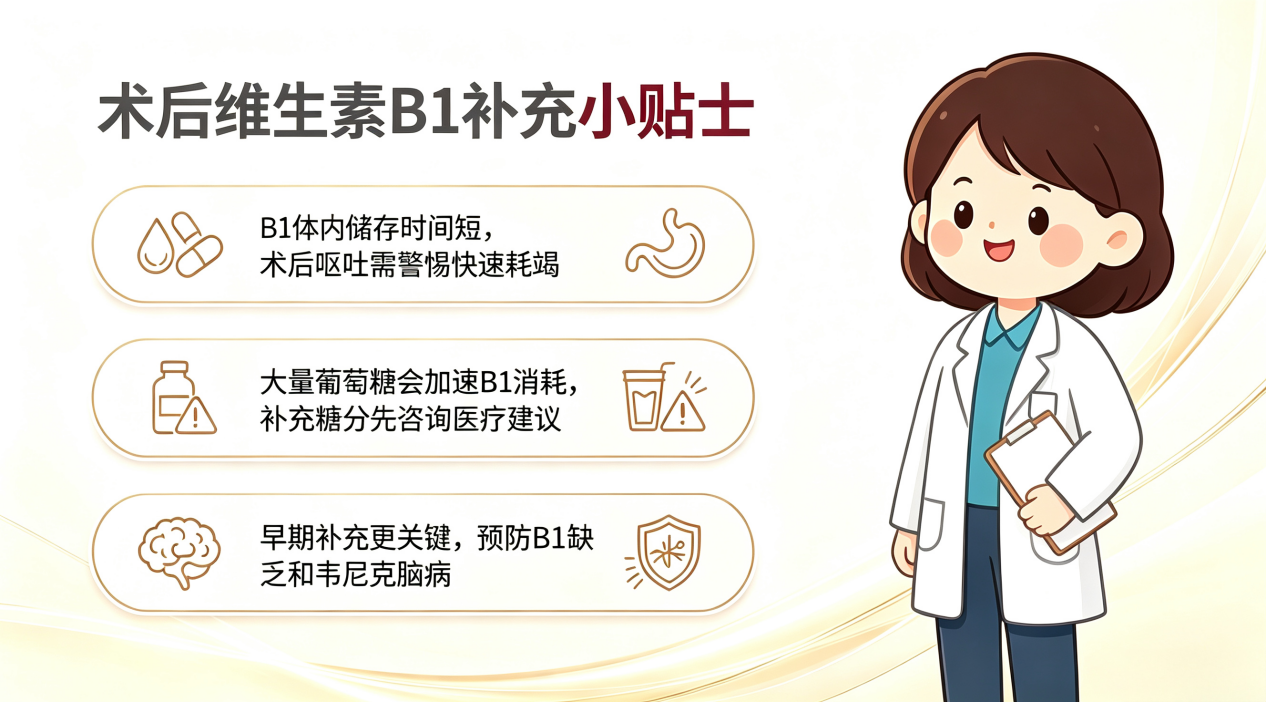
- 维生素B1是水溶性维生素,机体无法大量储存,且体内B1储存库的半衰期仅为9~18天。减重术后以流质、半流质饮食为主,进食全谷物、肉类、豆类等富含B1的食物减少,加之胃部不适导致频繁呕吐,B1随胃液丢失,是术后急性B1缺乏的高危诱因。若术后持续呕吐,需要高度警惕B1快速耗竭。
- 维生素B1是人体葡萄糖代谢的关键辅酶。频繁呕吐导致机体处于饥饿或血糖偏低状态,家属可能会给予果汁或者蜂蜜水帮助补充体力,此时大量葡萄糖进入机体会加速消耗B1,严重时甚至诱发急性韦尼克脑病。在临床上,术后进行葡萄糖补液时通常会优先或同时补充B1。因此,术后频繁呕吐的小伙伴在补充糖分时一定要注意,建议咨询专业医疗建议。
- 韦尼克脑病是由严重维生素B1缺乏引发的神经系统损害,典型临床表现为“三联征”:精神、意识状态改变(淡漠、嗜睡、反应迟钝、意识混乱),眼肌麻痹或眼球震颤,及共济失调(走路摇晃、站立不稳、容易摔倒),然而实际上仅有不到三分之一的患者会出现完整的三联征表现,多数仅表现为淡漠、记忆力下降、步态不稳,极易被误认为术后体虚。临床共识为:合理怀疑,即刻治疗。若不及时纠正,可发生不可逆的神经细胞坏死,遗留持久性记忆损伤,甚至死亡。术后及早补充,预防B1缺乏,健康收益更高。
结束语
一起学习和推广健康减重的方法和理念!
- 参考文献:
- Mechanick J I, Apovian C, Brethauer S, et al. Clinical practice guidelines for the perioperative nutrition, metabolic, and nonsurgical support of patients undergoing bariatric procedures - 2019 update: cosponsored by American Association of Clinical Endocrinologists/American College of Endocrinology, The Obesity Society, American Society for Metabolic & Bariatric Surgery, Obesity Medicine Association, and American Society of Anesthesiologists[J]. Surg Obes Relat Dis, 2020, 16(2): 175–247.
- Benson-Davies S, Frederiksen K, Patel R. Bariatric nutrition and evaluation of the metabolic surgical patient: Update to the 2022 Obesity Medicine Association (OMA) bariatric surgery, gastrointestinal hormones, and the microbiome clinical practice statement (CPS)[J]. Obes Pillars, 2025, 13: 100154.
- 王勇, 梁辉, 张频, 等. 中国肥胖及代谢疾病外科治疗指南(2024版)[J]. 中国实用外科杂志, 2024, 44(8): 841–849.
- 国家卫生健康委员会肥胖症诊疗指南编写委员会. 肥胖症诊疗指南(2024年版)[J]. 中国循环杂志, 2025, 40(1): 6–30.
- Yu A T, Gross A, Park K, et al. Wernicke Encephalopathy After Bariatric Surgery: a Literature Review[J]. Obes Surg, 2023, 33(11): 3621–3627.
声明:博客内容仅为营养健康科普参考,仅供医学专业人士阅览,文中内容不构成任何诊疗、用药建议,营养补充方案需结合个体情况、定期随访结果,在专业医护指导下实行,特殊人群(孕期、慢性病等)请提前就医评估。本文知识产权归拜瑞斐所有,未经授权,不得转载。