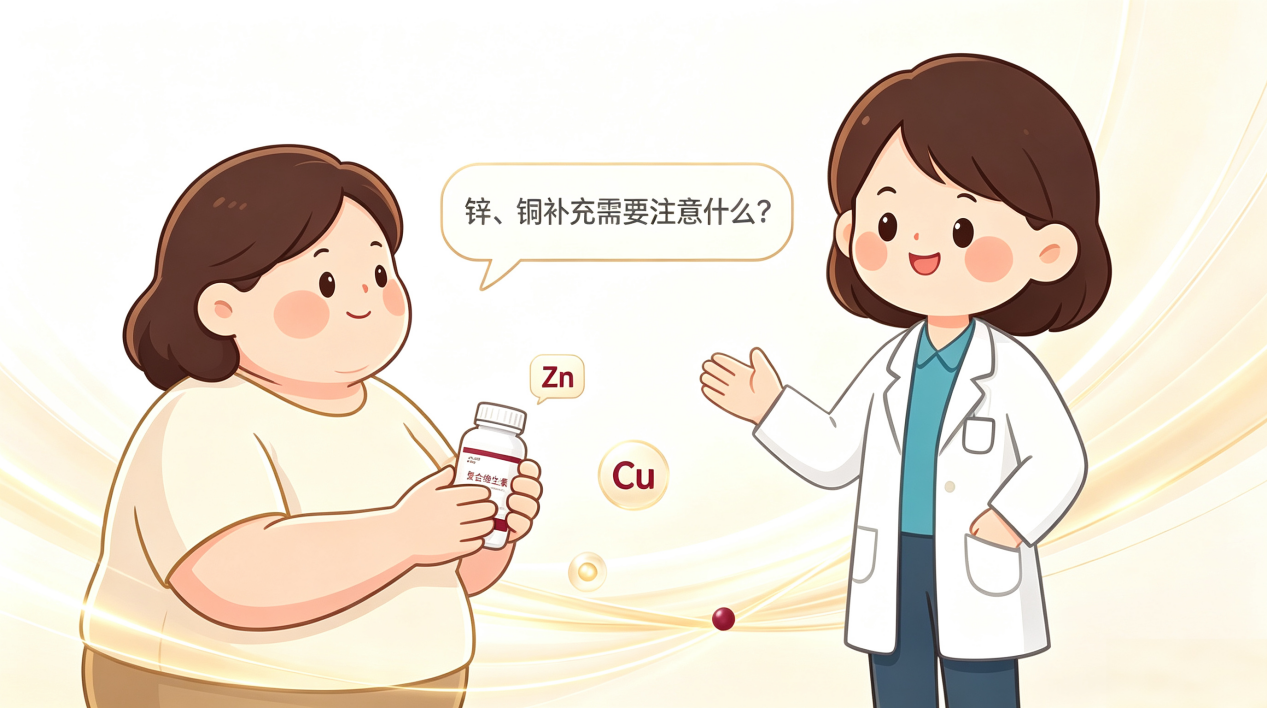
减重术后服用复合维生素已成为普遍共识,旨在全面补足术后所需营养,相比于维A、维B、钙、铁等熟知的营养素,锌和铜大多是作为其中的成分被一同摄入。事实上,锌会显著影响铜的肠道吸收,二者不仅需要适宜的配比,矿物质剂型还需要适配术后的低胃酸生理环境。若配比不当或吸收形态不佳,可能会在不知不觉中对头发健康、造血功能或肢体感知产生影响。本文基于权威医学指南,梳理术后锌、铜缺乏风险、适合术后肠胃环境的合理配比与剂型特点。
Original Passage
At 5 years postoperatively, 21.15% and 44.94% of patients, respectively, have low zinc levels after RYGB and BPD/DS.
At 5 years postoperatively, 13.48% and only 1.92% of patients had low copper levels after RYGB and BPD/DS, respectively. This compares with patients undergoing Roux-en-Y reconstruction for gastric cancer, in whom copper deficiency was relatively infrequent (5.9%) and symptoms were rare. In the same study, copper levels among those having RYGB or BPD/DS were lower with younger age, shorter follow-up (<3 yr), and male sex.
Zinc
Supplementation to prevent deficiency:
All post-WLS patients should take ≥RDA zinc, with dosage based on type of procedure:
- BPD/DS: Multivitamin with minerals containing 200% of the RDA (16-22 mg/d)
- RYGB: Multivitamin with minerals containing 100%-200% of the RDA (8-22 mg/d)
- SG/LAGB: Multivitamin with minerals containing 100% of the RDA (8-11 mg/d)
The supplementation protocol should contain a ratio of 8-15 mg of supplemental zinc per 1 mg of copper to minimize the risk of copper deficiency.
The formulation and composition of zinc supplements should be considered in post-WLS patients to calculated accurate levels of elemental zinc provided by the supplement.
Repletion for patients with deficiency:
A dose-related recommendation for repletion cannot be made due to insufficient evidence.
Repletion doses should be chosen carefully to avoid inducing a copper deficiency.
Zinc status should be routinely monitored using consistent parameters throughout treatment.
Copper
Supplementation to prevent deficiency:
All post-WLS patients should take ≥RDA copper as part of routine multivitamin and mineral supplementation, with dosage based on type of procedure:
- BPD/DS or RYGB: 200% of the RDA (2 mg/d)
- SG or LAGB: 100% of the RDA (1 mg/d)
Supplementation with 1 mg copper is recommended for every 8-15 mg of elemental zinc to prevent copper deficiency in all post-WLS patients.
Copper gluconate or sulfate is the recommended source of copper for supplementation.
Repletion for patients with deficiency:
Recommended repletion regimen varies with severity of deficiency:
- Mild to moderate (including low hematologic indices): 3-8 mg/d oral copper gluconate or sulfate until indices return to normal.
- Severe: 2–4 mg/d intravenous copper can be initiated for 6 d or until serum levels return to normal and neurologic symptoms resolve.
- Copper levels should be monitored every 3 months after they return to normal.
中文译文
术后5年,在接受RYGB和BPD/DS的患者中,锌水平偏低的比例分别为21.15%和44.94%。
术后5年,在接受RYGB和BPD/DS的患者中,铜水平偏低的比例分别为13.48%和仅1.92%。相比之下,在因胃癌接受Roux-en-Y重建的患者中,铜缺乏相对少见(5.9%),且极少出现相关症状。在同一项研究中,接受RYGB或BPD/DS的患者若年龄较轻、随访时间较短(<3年)或是男性,其铜水平相对更低。
锌:
预防缺乏的补充方案:
所有减重术后患者均应补充至少达到推荐膳食供给量(≥RDA)的锌剂,具体剂量取决于手术类型:
- BPD/DS:补充含有200% RDA的含矿物质复合维生素(16–22毫克/天)
- RYGB:补充含有100%–200% RDA的含矿物质复合维生素(8–22毫克/天)
- SG/LAGB:补充含有100% RDA的含矿物质复合维生素(8–11毫克/天)
补充方案应设定为每1 mg铜对应8-15 mg补充锌的剂量比,以最大限度降低诱发铜缺乏的发生风险。
对于接受过减重手术的患者,应考虑其补锌剂的配方与成分,以便准确计算该补剂所提供的元素锌含量。
缺乏患者的补充治疗:
由于证据不足,目前无法给出针对补充治疗的具体推荐剂量。
选定补充治疗剂量时应十分谨慎,以避免引发铜缺乏。
在整个治疗期间,应采用一致的监测指标对锌营养状况进行常规监测。
铜:
预防缺乏的补充方案:
所有减重术后患者均应补充至少达到推荐膳食供给量(≥RDA)的铜作为常规复合维生素和矿物质补充的一部分,具体剂量取决于手术类型:
- BPD/DS或RYGB:200% RDA(2毫克/天)
- SG或LAGB:100% RDA(1毫克/天)
为防止所有减重术后患者发生铜缺乏,建议每补充8-15毫克元素锌,同时补充1毫克铜。
推荐葡萄糖酸铜或硫酸铜作为铜的补充来源。
缺乏患者的补充治疗:
推荐的补充治疗方案因缺乏严重程度而异:
- 轻度至中度缺乏(包括血液学指标偏低):口服葡萄糖酸铜或硫酸铜3-8毫克/天,直至指标恢复正常。
- 重度缺乏:可开始静脉注射铜剂2-4毫克/天,持续6天或直至血清水平恢复正常且神经系统症状缓解
- 血铜水平恢复正常后,应每3个月监测一次。
国内指南
SG术后锌缺乏发生率为19%,建议补充锌8~11 mg/d;RYGB术后锌缺乏发生率为40%,建议补充锌8~22 mg/d。RYGB术后铜缺乏发生率为10%~20%,建议每天铜补充剂量为普通人群推荐摄入量的2倍(2 mg/d);SG术后铜缺乏很少见,按普通人群推荐摄入量(1 mg/d)补充即可。
——中国肥胖及代谢疾病外科治疗指南(2024版)
小贴士
- 锌和铜的主要吸收部位是十二指肠和近端空肠,RYGB、BPD-DS这类吸收不良型术式会旷置该段小肠,导致术后锌和铜缺乏风险较高;限制型术式(SG、LAGB)虽然保持了消化道完整性,但因胃容量缩小导致摄入量骤减,且SG还会切除胃壁,导致胃酸分泌大幅减少,不利于矿物质的解离吸收,因而同样存在缺乏风险。
- 锌缺乏,身体常表现出严重脱发、伤口愈合缓慢、味觉减退或异常、反复发生皮肤炎以及免疫力低下;铜缺乏,主要表现为顽固性贫血、白细胞减少,严重时还会引发手脚麻木、肢体无力和步态不稳等脊髓神经病变。
- 指南指出,可在术后补充含矿物质的复合维生素预防锌、铜缺乏,但需要注意制剂中二者含量的平衡。长期大剂量补锌会刺激肠道上皮细胞合成金属硫蛋白(Metallothionein,MT),该蛋白对铜有更强的亲和力,容易将铜截留在肠细胞内。肠黏膜细胞通常数天便会自然衰老脱落,被截留的铜随之经粪便排出体外,长此以往容易诱发继发性铜缺乏。因此,建议将锌铜比控制在8~15:1这一安全范围,在满足锌补充需求的同时,尽可能规避锌过量造成的铜耗竭风险。
- 除了8~15:1的安全黄金比例外,矿物质剂型的选择同样决定了吸收效果,建议优先选择有机酸(如柠檬酸盐、葡萄糖酸盐)或氨基酸螯合矿物质。因为相比于无机矿物质剂型,这种剂型对胃酸依赖度更低,在术后低胃酸环境下也能快速溶解解离,同时性质更温和,对肠胃刺激性更小。

结束语
一起学习和推广健康减重的方法和理念!
- 参考文献:
- Mechanick J I, Apovian C, Brethauer S, et al. Clinical practice guidelines for the perioperative nutrition, metabolic, and nonsurgical support of patients undergoing bariatric procedures - 2019 update: cosponsored by American Association of Clinical Endocrinologists/American College of Endocrinology, The Obesity Society, American Society for Metabolic & Bariatric Surgery, Obesity Medicine Association, and American Society of Anesthesiologists[J]. Surg Obes Relat Dis, 2020, 16(2): 175–247.
- 王勇, 梁辉, 张频, 等. 中国肥胖及代谢疾病外科治疗指南(2024版)[J]. 中国实用外科杂志, 2024, 44(8): 841–849.
- 国家卫生健康委员会肥胖症诊疗指南编写委员会. 肥胖症诊疗指南(2024年版)[J]. 中国循环杂志, 2025, 40(1): 6–30.
- 声明:博客内容仅为营养健康科普参考,仅供医学专业人士阅览,文中内容不构成任何诊疗、用药建议,营养补充方案需结合个体情况、定期随访结果,在专业医护指导下实行,特殊人群(孕期、慢性病等)请提前就医评估。本文知识产权归拜瑞斐所有,未经授权,不得转载。